

SCHOOL SECURITY: EVERY PARENT DESERVES ANSWERS BEFORE THEIR CHILD'S SAFETY IS PUT AT RISK
Are School Districts Selecting the Most Qualified Security Providers—or Simply the Lowest Bidder or Preferred Vendor?
By Joseph Sordi
Chief Executive Officer, Strategic Security Corp.
Retired New York City Police Department Officer | School Security and Public Safety Professional
Every morning, millions of parents send their children to school with one fundamental expectation: that the school district has taken every reasonable precaution to protect them.
Parents trust superintendents, school administrators, and elected Boards of Education to make informed, responsible decisions about school safety. Yet one of the most consequential decisions a district makes—who is entrusted to provide armed security at its schools—often receives far less public scrutiny than it deserves.
After more than two decades in the private security industry, including extensive experience evaluating and responding to government and school district security solicitations, I have developed serious concerns about how some districts establish security requirements, evaluate contractors, and ultimately award contracts.
My greatest concern is not simply whether a school has an armed security officer. It is whether that officer, the company employing that officer, and the district overseeing the program are genuinely prepared to prevent, respond to, and survive a life-threatening emergency.
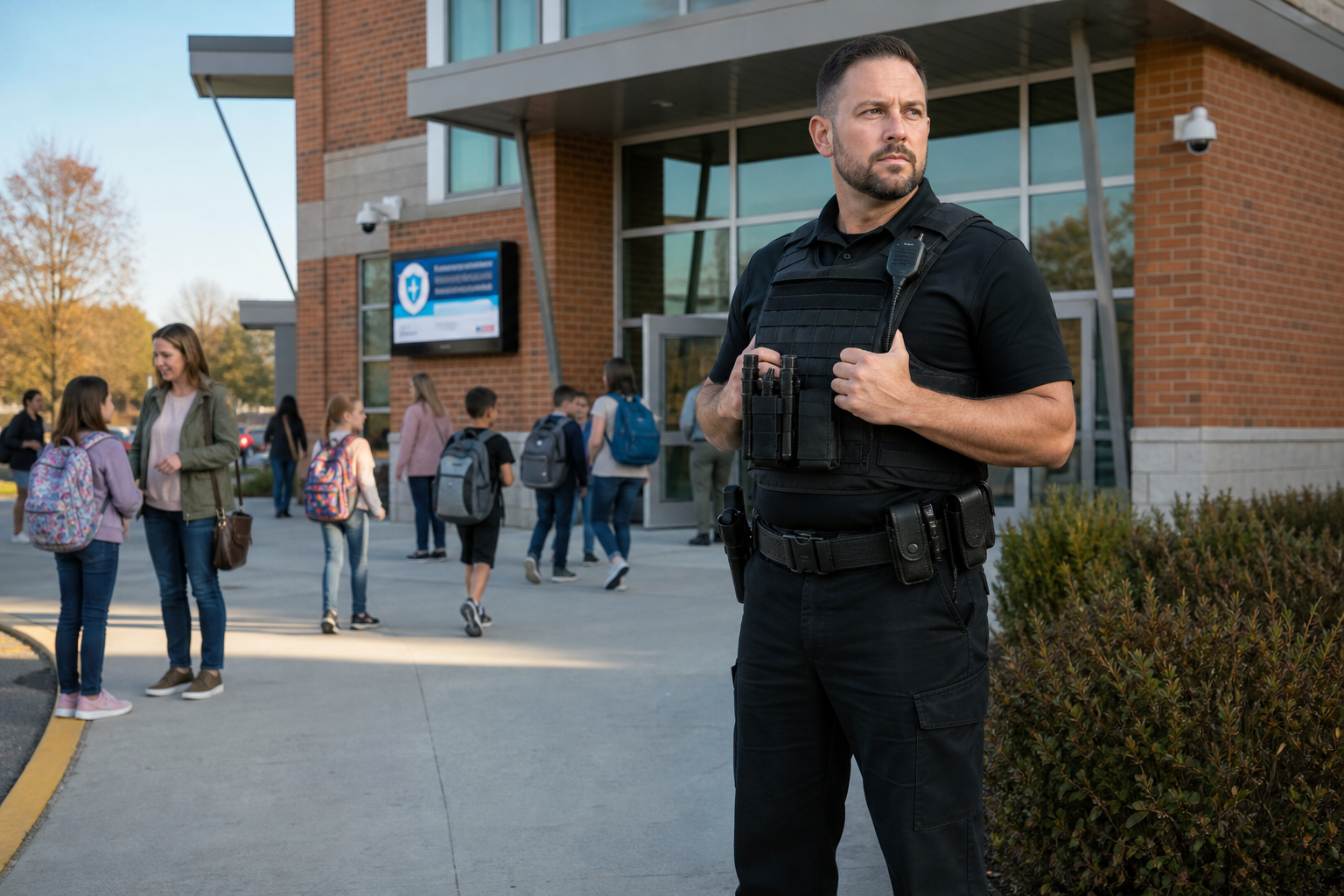
An armed security officer standing at the front entrance may create a perception of safety. But perception is not preparedness, and a uniform and firearm do not automatically translate into effective protection.
Parents should demand more than assurances. They should demand evidence.
1. Who Decides How Many Armed Security Officers Are Enough?
A common staffing model in school security solicitations assigns one armed security officer to an elementary or middle school and two officers to a high school.
But who determined those numbers? What professional risk assessment supports that deployment?
Was the decision based on a comprehensive evaluation of the school's physical layout, student population, entrances and exits, building configuration, emergency response times, existing security technology, and potential threats?
Or was it simply a staffing model adopted because other districts use it or because it fits an established budget?
Consider a high school with 2,000 students, multiple buildings, athletic facilities, numerous access points, and hundreds of students arriving within a short period.
Can two armed officers reasonably perform access control, monitor suspicious behavior, assist with visitor screening, respond to medical emergencies, conduct patrols, and maintain the capability to respond immediately to an active threat?
What happens when one officer is assisting with a disturbance on the opposite side of the building?
What happens when another officer is occupied with an emergency medical incident?
If the district cannot explain why its staffing model is sufficient, parents should question whether the deployment was designed around actual security risks or merely around available funding.
Security staffing should be determined by a documented, site-specific threat and vulnerability assessment—not by arbitrary staffing ratios.
2. Are Districts Considering the Security Technology and Screening Procedures Already in Place?
Security officers do not operate in isolation. Their effectiveness depends heavily on the security measures surrounding them.
Districts must evaluate whether their staffing plans adequately account for magnetometers, weapons-detection systems, student screening procedures, surveillance cameras, intelligent video analytics, visitor management systems, electronic access controls, and emergency notification technology.
For example, if a school utilizes magnetometers or weapons-detection systems, how many students can realistically be screened during morning arrival without creating excessive delays or dangerous crowding?
Who responds when an alarm is activated?
Who supervises students waiting to enter?
Who maintains security coverage elsewhere while officers investigate a potential weapon?
Similarly, if a district invests in advanced video analytics capable of identifying potential threats, who is monitoring the system, verifying alerts, and coordinating an appropriate response?
Technology without trained personnel, clear procedures, and sufficient staffing can create an illusion of security.
Parents should ask whether the district has evaluated how its security officers, technology, and emergency procedures function together as one coordinated protective system.
3. Does Prior Law Enforcement Experience Automatically Make Someone Qualified to Protect a School?
Absolutely not.
Many school districts place considerable emphasis on hiring retired law enforcement officers or military veterans. These backgrounds can provide valuable experience, but they should never substitute for rigorous, current, and independently verified qualifications.
The ability to perform effectively as a police officer 10 or 20 years ago does not establish someone's present ability to respond to an armed attacker inside a crowded school or outside on school grounds.
Firearms proficiency, physical conditioning, tactical judgment, situational awareness, and the ability to make sound decisions under extreme stress are perishable capabilities.
In New York, the training and qualification requirements applicable to armed security personnel are not necessarily equivalent to the standards a security company should establish for an officer assigned to protect children.
For example, New York's armed security training framework includes annual firearms training, but annual qualification alone does not establish readiness for a dynamic, high-stress school emergency. Applicable standards and qualification scores also depend on the training program and licensing requirements.
The level of our training is reflected in our pricing as when most law enforcement officers when they were actively employed by their agency would qualify only 1-2 times a year with their agency requiring a passing score of 75-80%. Accuracy is a perishable skill as people age, thus when an officer retires they only have to qualify once per year with a passing score of 70% to maintain an armed security officer license in NYS.
At Strategic Security Corp., our approach goes substantially beyond minimum qualification requirements.
Our internal armed-officer standards include:
- Quarterly firearms qualification, with a company-established 100% performance requirement.
- Ballistic body armor appropriate to the assigned protective duties.
- Scenario-based active-shooter response and live-fire tactical training conducted under controlled, professionally supervised conditions.
- Training in movement, room-clearing principles, threat identification, and decision-making under stress.
- Physical fitness and functional readiness assessments.
- Continuing evaluation of judgment, de-escalation skills, professionalism, and suitability for the school environment.
These enhanced standards require substantial investment, which is reflected in the cost of providing qualified personnel.
There is also an uncomfortable reality that school districts must be willing to confront: some retired officers may no longer possess the physical capabilities required to perform the most demanding aspects of armed school security.
Can the officer move quickly through a large school? Climb several flights of stairs while carrying equipment? Maintain physical control and sound judgment under extreme stress? Respond effectively while wearing protective equipment?
These are legitimate occupational performance questions—not criticisms of age or prior service.
A school district should not assume an officer is prepared for an active-shooter incident simply because that individual previously carried a badge.
A $250,000 Challenge to the School Security Industry
I am so confident in the distinction between minimum licensing requirements and our company's enhanced selection and training standards that I am prepared to propose a $250,000 challenge to security companies currently providing armed security at Long Island schools.
The challenge is straightforward: demonstrate that your currently deployed school security officers can successfully complete Strategic Security Corp.'s established selection, firearms proficiency, tactical readiness, and physical performance requirements. If all of your staff cannot you cease your contract.
Any formal challenge would be subject to independently administered testing conditions, eligibility requirements, and written terms.
The purpose is not publicity for its own sake. It is to draw attention to a question every school district should be asking:
If the officer protecting your child had to respond to an active shooter tomorrow, what objective evidence demonstrates that the officer is physically, tactically, and professionally prepared?
4. Are School Security Contracts Being Awarded Based on Qualifications—or Relationships?
This is perhaps one of the most troubling issues in school security procurement.
School districts frequently issue requests for proposals that contain broad, ambiguous language concerning qualifications, staffing, training, experience, operational capacity, and evaluation criteria.
In some cases, the solicitation provides little meaningful detail about the standards by which competing security companies will be evaluated.
That ambiguity can create opportunities for inconsistent scoring, subjective judgments, and potentially preferential treatment.
Consider the following hypothetical procurement scenario, reflecting the types of concerns that can arise in competitive security contracting:
A newly established security company, formed approximately two months before proposals are due, submits a bid to provide armed security services to a school district.
The company has no documented operating history, no established school security past performance, no registered employees at the time of bidding, no demonstrated physical operating infrastructure beyond a home office or virtual address, and no independently verified financial capacity to support the proposed contract.
Meanwhile, established security companies with more than 20 years of operating experience, substantial personnel resources, documented performance histories, established management infrastructure, and demonstrated financial capacity submit competing proposals.
Yet the newly formed company receives a higher technical evaluation and ultimately wins the contract.
Such an outcome is not, by itself, evidence of misconduct. A new company may legitimately offer a superior proposal, and not every procurement requires the same financial or operational qualifications.
But it raises important questions.
What specific criteria justified the higher score?
How did the district verify the company's ability to recruit, train, supervise, equip, and continuously deploy the required armed officers?
Did the district examine financial statements, references, insurance, licensing, and operational readiness?
Were all bidders evaluated against the same published criteria?
And if members of the evaluation committee had an existing personal, professional, or financial relationship with the selected vendor, was that relationship disclosed and appropriately addressed?
A school security contract should never become a vehicle for rewarding personal relationships, political connections, or preferred vendors at the expense of demonstrable qualifications.
When a district cannot provide a documented, objective explanation for its selection, public confidence suffers.
Parents and taxpayers should expect transparent evaluation standards, consistent scoring, appropriate conflict-of-interest safeguards, and meaningful due diligence.
5. Does the Selected Security Company Actually Have the Infrastructure to Deliver?
A security company is much more than a business license and a collection of officers.
A capable security provider needs the organizational infrastructure to recruit qualified personnel, verify credentials, conduct training, provide supervision, replace absent employees, manage emergencies, investigate incidents, maintain records, and remain financially stable.
Before awarding a school security contract, districts should examine whether a prospective contractor possesses:
- Established operational leadership and qualified field supervisors.
- Documented recruiting, background screening, and credential-verification procedures.
- Sufficient staffing reserves to cover absences, vacations, illness, and unexpected vacancies.
- Training programs supported by documented records and qualified instructors.
- Appropriate insurance and financial resources.
- Reliable emergency communications and escalation capabilities.
- A documented history of contract performance, or other credible evidence of equivalent operational capacity.
A contractor may offer an attractive hourly rate while lacking the resources necessary to fulfill the contract consistently.
What happens when three officers call out sick?
Who provides replacements?
How quickly must they arrive?
Who confirms the replacements are properly licensed, trained, equipped, and familiar with the school?
If the contractor lacks a functioning management and supervisory structure, the burden may ultimately fall on school administrators who were never intended to manage a security workforce.
A low hourly rate means very little if the contractor cannot reliably provide the service the district believed it was purchasing.
6. What Happens During an Actual Emergency?
Every district should have written procedures that clearly establish the responsibilities of security officers, school administrators, district security leadership, and responding law enforcement agencies.
Those procedures must address far more than calling 911.
Who makes the initial threat assessment?
Who initiates a lockdown or other protective action?
Who communicates with responding police?
Who provides information about the location and description of a suspected attacker?
Who coordinates emergency medical assistance?
How are security officers identified to responding law enforcement personnel?
What happens if the primary communications system fails?
And critically, have these procedures actually been exercised under realistic conditions?
A security plan that exists only in a binder is not evidence of operational readiness.
Districts should conduct appropriately designed, age-sensitive emergency exercises that evaluate communications, decision-making, command responsibilities, and coordination with public-safety agencies without unnecessarily traumatizing students.
During a real emergency, confusion about responsibilities can cost precious time.
7. Who Is Holding the Security Contractor Accountable?
Awarding a contract is only the beginning of the district's responsibility.
How does the district know that officers are arriving on time, remaining at their assigned posts, conducting required patrols, maintaining certifications, and complying with established procedures?
Are attendance records independently verified?
Are supervisors conducting documented inspections?
Are incident reports reviewed for completeness, accuracy, and trends?
Are deficiencies tracked until corrected?
Does the district have measurable performance standards and contractual remedies when the provider fails to meet its obligations?
These are basic contract-management requirements that should be established before services begin.
Without meaningful oversight, even a well-written security contract can deteriorate into little more than an expensive staffing arrangement.
A district should not have to wait for a serious incident to discover that its contractor has failed to provide adequate supervision, training, or coverage.
8. Is the Lowest Price Really the Best Value When Children's Lives Are at Stake?
School districts have legitimate financial responsibilities. They must manage taxpayer resources prudently and follow applicable procurement requirements.
But there is a difference between fiscal responsibility and purchasing security services without adequately evaluating the cost of delivering them safely.
Enhanced firearms training, ballistic protective equipment, physical readiness assessments, qualified supervisors, continuous training, staffing reserves, and operational infrastructure all carry costs.
A company that invests substantially in those capabilities may have a higher hourly rate than a competitor providing only the minimum required by law.
That does not automatically make the higher-priced company the better choice. It does mean the district should evaluate what each proposed price actually includes.
Are the officers equipped with ballistic protection?
How frequently do they qualify with their firearms?
What are their documented physical performance standards?
How often do they receive realistic scenario-based training?
What supervisory resources are included?
What is the contractor's documented ability to replace absent personnel?
These are measurable differences that should be reflected in the evaluation process.
The objective should not be to purchase the cheapest armed officer. It should be to obtain the most effective, reliable, and accountable security program at a defensible cost.
9. What Every Parent Should Demand From Their School Board
Parents should not need specialized knowledge of security contracting to obtain meaningful answers.
At a minimum, every Board of Education should be prepared to explain:
- Risk Assessment: When was the last independent, site-specific school security assessment conducted, and how did it determine staffing levels?
- Officer Qualifications: What firearms, tactical, physical fitness, de-escalation, and school-specific training standards must every armed officer satisfy?
- Protective Equipment: Are armed officers equipped with appropriate ballistic protection and emergency communications equipment?
- Emergency Readiness: How are security personnel integrated into the district's emergency response plans and coordination with local law enforcement?
- Contractor Experience: What documented past performance, operational infrastructure, staffing capacity, and financial resources were verified before contract award?
- Procurement Integrity: What objective evaluation criteria were used, how were proposals scored, and what conflict-of-interest safeguards protected the selection process?
- Staffing Reliability: What contractual requirements govern missed shifts, emergency replacements, supervisory inspections, and continuity of coverage?
- Performance Accountability: What measurable standards are used to monitor the contractor, and what happens when those standards are not met?
- Technology Integration: How do screening systems, surveillance technology, access controls, and security staffing operate together?
- Public Transparency: What non-sensitive information can the district provide to demonstrate that its security program is effective and that public funds are being spent responsibly?
Certain tactical details must remain confidential to avoid compromising school security. But confidentiality should never become a blanket excuse for withholding basic information about contractor qualifications, procurement integrity, and performance accountability.
10. School Boards Must Remember Who They Serve
Members of a Board of Education are entrusted with public resources and decisions that affect the safety and welfare of children.
That responsibility demands independent judgment, appropriate oversight, and a willingness to ask difficult questions—even when those questions challenge the recommendations of district administrators or established vendors.
School security procurement should not be a popularity contest, a relationship-driven selection process, or an exercise in identifying the least expensive hourly rate.
It should be a rigorous evaluation of risk, capability, readiness, and accountability.
A newly formed company should not automatically be excluded simply because it is new. Nor should an established company automatically receive preference because of its size or longevity.
But every company, regardless of age or reputation, should be required to substantiate its ability to perform the contract.
If a district selects a contractor with limited experience over an established provider, it should be able to explain, with documented and defensible evidence, why that selection better satisfies the district's published requirements.
If the evaluation process cannot withstand reasonable public scrutiny, the process deserves examination.
The Bottom Line: Security Is Measured by Preparedness, Not Appearances
After decades of experience in law enforcement and private security, I believe one of the most dangerous assumptions in school protection is that placing an armed individual inside a building automatically makes that building secure.
It does not.
Effective school security requires properly assessed risks, qualified and physically capable personnel, realistic training, appropriate protective equipment, reliable communications, operational oversight, and an accountable contractor.
Most importantly, it requires school administrators and elected board members who are willing to verify those capabilities rather than simply accept assurances.
Every parent should ask one final question:
If an armed attacker entered my child's school tomorrow, could the district demonstrate—through documented training, testing, staffing assessments, and emergency preparedness—that it had taken reasonable steps to ensure its security personnel were ready to respond?
If the answer is uncertain, there is more work to be done.
Because the time to discover deficiencies in a school security program is not after a tragedy.
Our children deserve more than the appearance of security. They deserve demonstrated preparedness, professional competence, and accountability from every individual and organization entrusted with their protection.
About the Author
Joseph Sordi is the Chief Executive Officer of Strategic Security Corp., a national security services provider with more than two decades of experience supporting government agencies and commercial organizations. A retired New York City Police Department officer, Sordi has extensive experience in armed security operations, protective services, emergency response, security workforce management, and government contracting. His professional work includes developing enhanced training, operational readiness, and accountability standards for armed security personnel.
The opinions expressed are those of the author and reflect his professional experience and perspective on school security procurement, operational readiness, and public accountability.
